The Birth of the Megaliths
For centuries, archaeologists looked at megaliths and saw wealth. They viewed these massive stone monuments as the confident output of societies entering a Golden Age. This series proposes a radically different view. We call it the Architecture of Anxiety.
The drive to drag multi-ton stones across the landscape was not born of confidence. It was born of fear. From the Atlantic shores of Brittany to the basalt plateaus of the Levant, the "Megalithic Phenomenon" appears precisely when societies face existential stress (Renfrew, 1976).
Whether it was hunter-gatherers facing the encroachment of farmers, or pastoral nomads facing aggressive city-states, the solution was identical: permanent stone. By anchoring their ancestors in the earth with immovable rock, these communities were not just burying their dead. They were issuing a defiant geopolitical statement: "We are here. This land is ours. We will not be moved" (Chapman, 1995).
The Physics of Stone: Structural Constraints of Prehistoric Megaliths
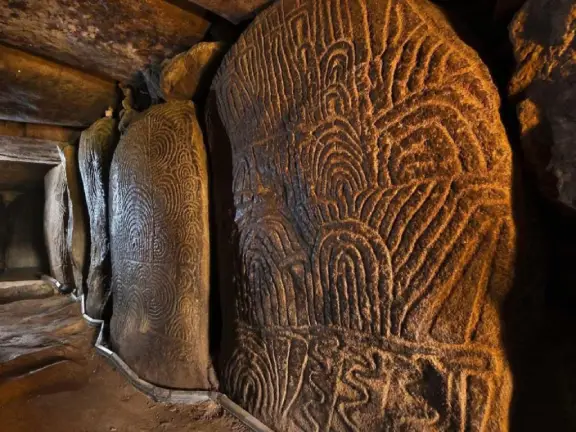
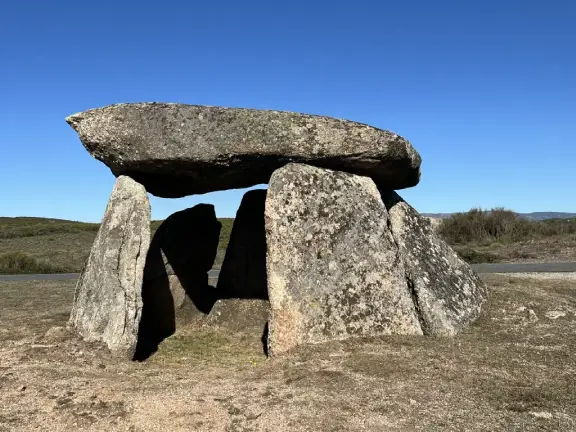
Stand before the Dolmen of Dombate in Galicia. Then, walk the stone corridor of Gavrinis in Brittany. The visual echoes are undeniable. For generations, this striking similarity birthed a romantic myth. Scholars imagined a "Megalithic Missionary", a culture of master craftsmen travelling the Atlantic coast. They supposedly taught ignorant locals a universal blueprint for building with stone.
But a simpler, grounded truth explains these shared silhouettes. It is a case of convergent evolution, dictated by the physics of stone (Joussaume, 1988).
The megalithic builders of Spain and France did not need a shared language. They did not need widespread communication networks to build identical tombs. They only needed to face the same physical constraints. Without the invention of mortar or the true arch, their architectural vocabulary was strictly limited. It was bound by gravity, muscle, and the tensile weakness of raw rock.
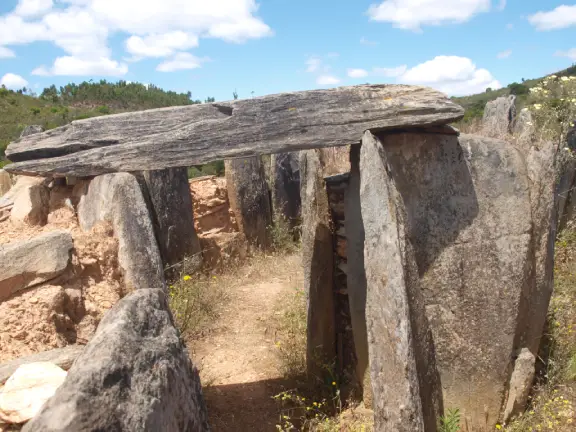
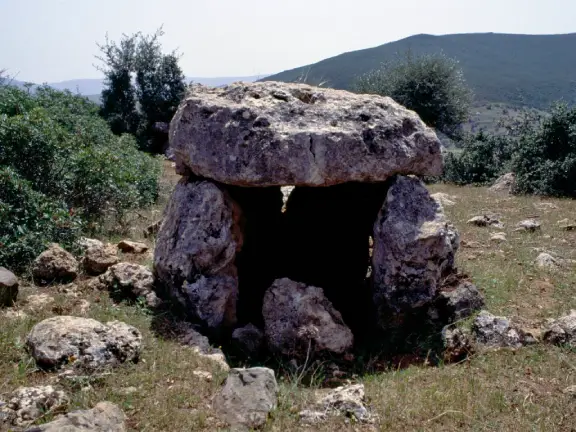
If you want to span a roof using a flat slab of stone, a technique known as post-and-lintel construction, the chamber must remain narrow. Otherwise, the capstone snaps under its own immense weight. If you want a taller, wider chamber, you are forced to use corbelling. This involves overlapping smaller stones in concentric rings until they meet at the top. The resulting "beehive" shape is not an imported stylistic choice. It is a mathematical inevitability (L'Helgouach, 1965).
These structures were never meant to stand naked against the sky. A dry-stone wall or a corbelled roof naturally wants to push outward and collapse. To prevent this, builders across the Mediterranean and beyond arrived at the same necessary solution. They packed thousands of tonnes of earth and rubble against the outside walls. This massive weight held the stone skeleton in compression (Mohen & Scarre, 2002).
This structural reality explains the most defining aesthetic of the megalith. There is an obvious contrast between the exterior and the interior. The outward-facing backs of these massive orthostats (upright stones) were left rough and unworked. Why waste thousands of hours shaping a surface no one would ever see? They were destined to be swallowed by the dark earth of the tumulus (burial mound).
The energy of the community was reserved entirely for the interior. Inward-facing surfaces were deliberately chosen for their flatness. They were painstakingly smoothed or covered in apotropaic (protective) art (Shee Twohig, 1981). The megalith was fundamentally an architecture of the interior. It was a carefully engineered womb in the earth. Here, the anxiety of the living could be resolved through the presence of the dead. The form did not follow a master craftsman’s design. It followed the absolute limits of the available technology (Cassen, 2009).
The Chronology of Crisis: Carbon-Dating Neolithic Social Stress
For decades, archaeologists obsessed over carbon-dating the monuments to draw a map. The goal was to find the absolute oldest dolmen, "Ground Zero" of the megalithic world, and trace how the architectural trend spread outward across centuries. This model relies on diffusionism (the theory that complex cultural traits originate in one advanced hub and radiate outward to less developed peripheries).
But if the "Architecture of Anxiety" holds true, we must tear up this map. If building with massive stones is a universal human reflex triggered by structural constraint and collective population stress, then the timeline tells a completely different story.
The building of megaliths did not start in one place and spread outward in a chronological wave. The sudden appearance of a stone tomb in a new region does not mark the arrival of a foreign missionary or a travelling master craftsman. It marks a breaking point.
The timeline of stone is not a map of ancient trade routes; it is a thermometer of social stress. The exact date that megaliths appear in a given region reveals the exact moment that specific population hit a demographic, environmental, or political wall.
When we see massive stone enclosures rise in Brittany around 4700 BC, it tells us when the local coastal populations first felt the crushing pressure of incoming farmers. When thousands of dolmens suddenly appear in the Levantine deserts nearly two millennia later, around 3000 BC, it is not because the "idea" of the dolmen took 1,700 years to reach the Middle East. It is because 3000 BC is the precise moment the local nomadic tribes felt critically threatened by the rise of the first walled city-states. And when the Thracians begin building them in Greece around 900 BC, it is a localized, desperate reaction to the chaos following the Bronze Age Collapse (Poplin, 1990).
The stones did not travel. The stress did. Megalithic architecture erupted spontaneously and independently whenever a pre-state society felt the walls of their world closing in.
The Megalithic Timeline: An Arc of Ancient Geopolitical Anxiety
We begin in Brittany around 4700 BC. We challenge the idea that settled farmers built these monuments to celebrate a harvest. Instead, evidence suggests they were built by communities at the edge. They were caught between old Mesolithic hunter-gatherer ways and the incoming Neolithic farming wave. The transition to stone was a desperate attempt to fix a fluid population to a specific coastline (Renfrew, 1976).
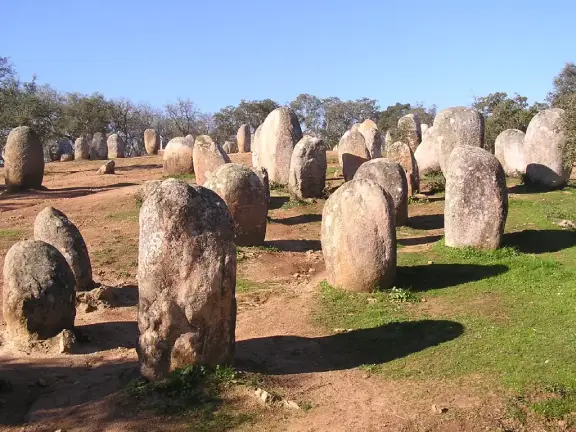
As the Neolithic population exploded in Portugal and Spain, arable land became scarce. This article views the antas (dolmens) not merely as tombs, but as deeds of ownership. We explore how the visual dominance of the dolmen in the Alentejo landscape served as a warning to rival clans. The bigger the stone, the stronger the claim (Chapman, 1995).
On islands like Sardinia and Malta, there is nowhere to run. When resources tightened, ritual escalated. We analyse the Sardinian Tombe dei Giganti (Giants' Tombs) and Maltese temples as pressure valves for social tension. The sheer collective effort required to build them forced social cohesion in a fragile ecosystem (Robb, 2007).
In North Africa, the environment itself forced a crisis. As the Sahara dried, pastoralists were pushed toward the coast. The thousands of dolmens at Roknia represent the frantic staking of grazing rights in a shrinking green world (Savage, 2001).
Moving to the Levant. In the Early Bronze Age Levant (c. 3000 BC), massive urban centres like Hazor and Megiddo began to dominate. The thousands of dolmens in the Golan and Jordan Valley were built by semi-nomadic populations outside the city walls. This was a counter-architecture. Nomads could not build palaces, so they built eternal tombs. It proved their ancestors owned the grazing lands long before the kings arrived (Prag, 1995).
We conclude with the anachronism of Thrace. Why did Iron Age tribes in the 9th century BC revert to building Neolithic-style dolmens? We argue it was a reaction to the chaos following the Bronze Age Collapse. In a world of refugees and shifting borders, the Thracians reached back to an ancient, mythical form of architecture. It manufactured a sense of stability and legitimacy (Poplin, 1990).
The "Megalithic Phenomenon" was not a single religion spread by missionaries. It was a universal human reflex. Whenever a pre-state society felt the walls closing in, whether from climate, overcrowding, or aggressive neighbours, they reached for the lever and the rock. They built to survive.